
About First Nations
First Nations honour and share the music, stories, and heritage of Southern Africa’s First Nations people.
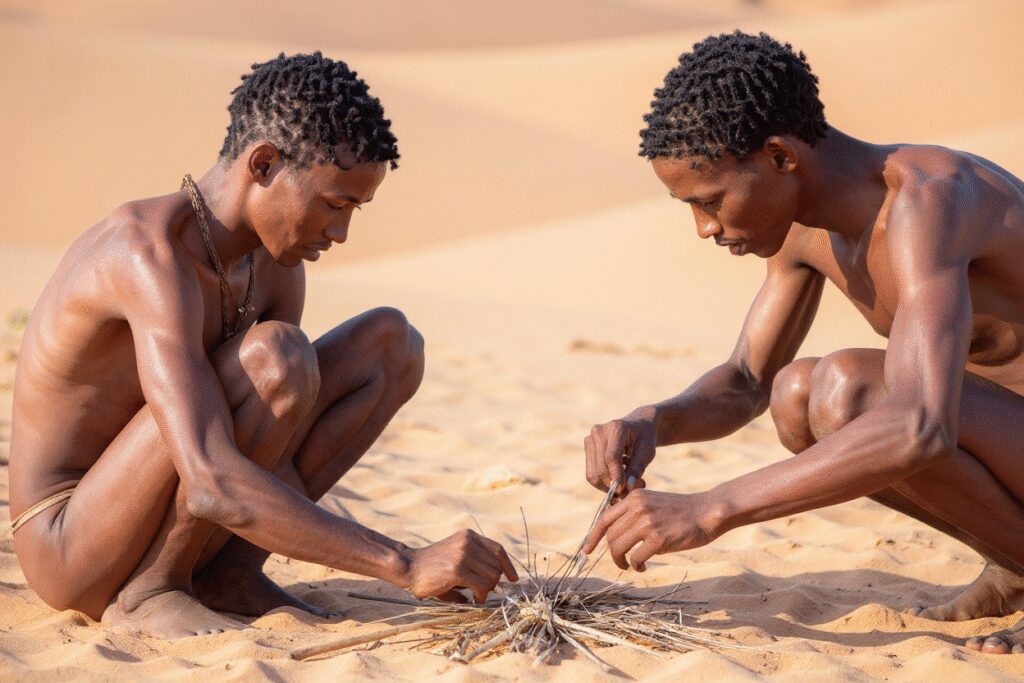
Archaeological evidence places the San (hunter-gatherers) and Khoekhoe (pastoralists) people among the earliest modern populations in Southern Africa, with histories and cultural traditions that span over 100,000 years [1]. I use the words San and Khoekhoe when I refer to a specific community. I also use the word Khoisan, to refer to the San and Khoekhoe communities collectively. The compound term Khoisan / Khoesān combines the words Khoekhoe and San and is a modern anthropological convention, coined by Leonhard Schulze in 1928 and made popular by Isaac Schapera and is commonly used today [2]. Historical writings about the Khoisan are limited and can be found in travellers’ letters, diaries, as well as archives from the Castle of Good Hope. The digitised Bleek and Lloyd archive, recorded in the 1870s presents the most substantive and complete documentation of the San, and is a UNESCO memory of the world. This collection contains 13 000 notebook pages, vocabularies, folktales, genealogies and illustrations of mainly one group of San, the |Xam. Bleek and Lloyd’s six |Xam consultants, were || kabbo, |a!kunta, Dia!kwain, |han≠kass’o, !kweiten ta|| ken, and ≠kasin, and were from the Katkop Hills and Strontberg in Northern Cape, near Kenhardt, the Langeberg Mountain range, north of Gariep in the territory known as Griqualand West, and Tweerivieren [3].
Preserving Heritage. Inspiring Futures.
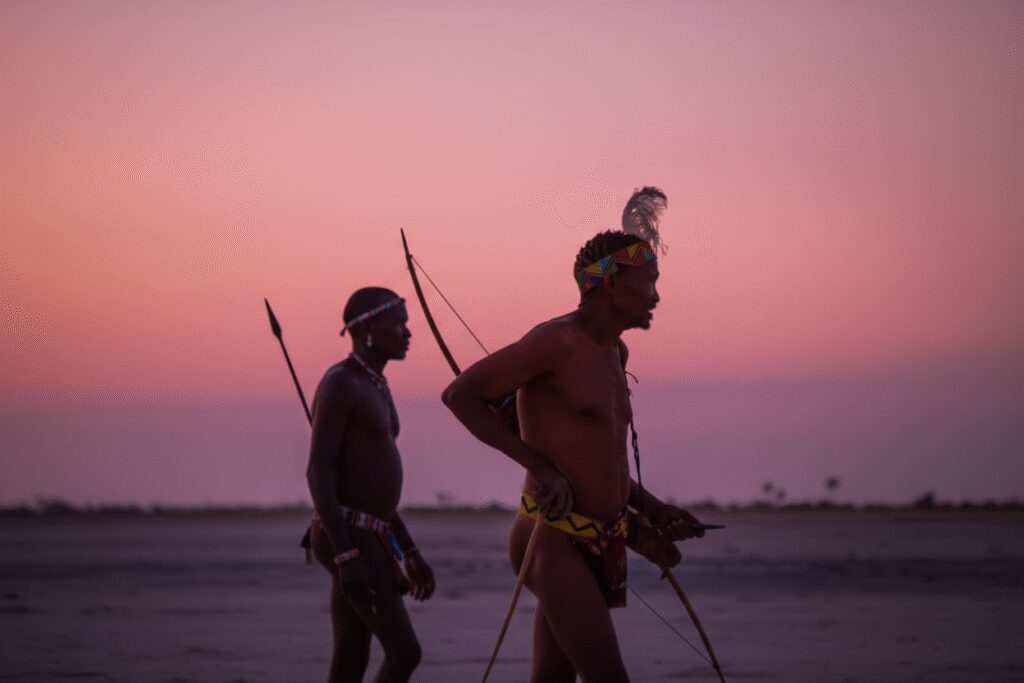
Besides the archive, we also rely on academic texts and archaeological evidence to learn more about the music of the Khoisan. Archaeologists inform us that musical instruments were used by the San for at least 10,000 years. Rock art in Attakwas and Ezeljagdspoort sites in the Klein Karoo, and Zimri Shelter and the Procession Shelter in the Cederberg, show human figures playing flutes. Artefacts, including bone flutes, spinning disks, bullroarers and other sound-producing implements were discovered from sites such as Klasies River Mouth and Matjes River [4]. Musical bows, which are the most iconic of the San instruments, are depicted in rock paintings across Southern Africa, including in the Drakensberg, Northeastern Cape, Maclear district, Namibia and can be dated between 4000 and 1800 years before present time (BP) [5]. Other instruments played by the Khoisan include ankle rattles, the gora, springbok horns, bull-roarer, kelp horn, reed flutes and the “rommelpot”, which is a clay pot covered with an animal skin [6].
Celebrating 100,000 Years of Heritage
Language and stories
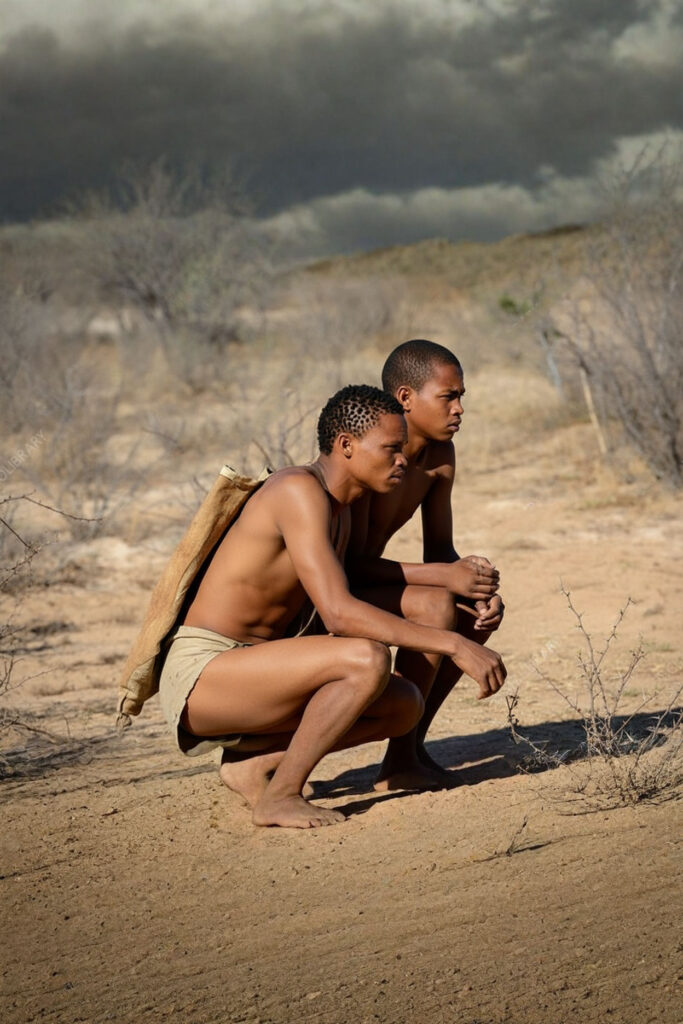
The Khoisan cultures are oral cultures, and their languages are characterised by distinctive click consonants, produced by creating suction with the tongue against various parts of the mouth. These clicks are represented by symbols like ǃ, ǂ, ǁ, and ǀ, and function as consonants in the phonological systems of San languages [6]. In oral cultures such as those of the Khoisan, knowledge is transmitted through narrative structures that serve to entertain, educate, provide moral instruction and to pass down the historical record. The storytelling traditions of the San, and specifically the |Xam, can be divided into categories, namely, legends, animal narratives, and the |Kaggen narratives. In San mythology, the mantis trickster figure |Kaggen, embodies both wisdom and folly. |Kaggen’s adventures are explored in complex narratives about human nature and the cosmic order. The eland, which also features in cave drawings and is linked to San mythology and rituals is revered as the most spiritually significant animal and usually appears in stories dealing with transformation and the relationship between human and spirit worlds. Music, rhythmic elements and chants are also distinctive features of San storytelling [8].
Culture and dance
A significant part of San culture is the healing trance dance, that combines music, dance and spirituality in ceremonies that transform the individual and community’s well-being [9]. The whole community participates in these ceremonies that last all night long, around the fire, and involves complex polyrhythmic clapping patterns, that are performed by women, while the men dance around the fire, often wearing ankle rattles and thereby produce more polyrhythms. The dance is also accompanied by call and response singing and yodelling. The repetitive nature of the music (singing and polyrhythms) induces the performers into an altered state of consciousness so that they fall into trance [10]. The San also celebrate various ceremonies and observe rituals that are important for initiation, life cycles, seasons, rainmaking, hunting, and marriage, with music and dance being central to these ceremonies [11].
References
References [1] Schlebusch, C.M., Skoglund, P., Sjödin, P., Gattepaille, L.M., Hernandez, D., Jay, F., Li, S., De Jongh, M., Singleton, A., Blum, M.G. & Soodyall, H. (2012). Genomic variation in seven Khoe-San groups reveals adaptation and complex African history. Science, 338(6105), pp.374-379. [2] Du Plessis, M. (2022). The Khoisan languages of Southern Africa: Facts, theories and confusions. In Rethinking Khoe and San Indigeneity, Language and Culture in Southern Africa, pp. 36-57, Routledge; Schapera, I. (1960). The Khoisan peoples of South Africa. London: Routledge & Kegan Paul Ltd. [3] de Villiers, A. & du Plessis, M. (2023). Historically informed performance: songs embedded in ǀXam stories. Ethnomusicology Forum. 32(3), pp. 411-439. [4] Rust, R., Kumbani, J., Rusch, N. and Wurz, S. (2022). Flute playing in the rock art of the Klein Karoo and Cederberg, South Africa-a potential link to ancient sound. Rock Art Research: The Journal of the Australian Rock Art Research Association (AURA), 39(1), pp.104-113; Kumbani, J. (2020). Music and sound-related archaeological artefacts from southern Africa from the last 10,000 years. Azania: Archaeological Research in Africa, 55(2), pp.217-241. [5] Vogels, O. & Lenssen-Erz, T. (2017). Beyond Individual Pleasure and Rituality: Social aspects of the Musical Bow in Southern Africa’s Rock Art. Rock Art Research 34 (1), pp. 9–24; Kumbani, J. & Vogels, O. (2022). Musical Bows in the Rock Art of Southern Africa. Oxford Research Encyclopedia of Anthropology. [6] Kirby, P. R. (1934). The Musical Instruments of the Native Races of South Africa. Oxford: Oxford University Press. [7] Ladefoged, P., & Traill, A. (1994). Clicks and their accompaniments. Journal of Phonetics, 22(1), pp. 33-64. [8] Guenther, M. (1999). Tricksters & Trancers. Bloomington, Indiana: Indiana University Press; Hewitt, R. (1986). Structure, meaning & ritual in the narratives of the Southern San. Johannesburg: Wits University Press; Bank, A. (2006). Bushmen in a Victorian world. Cape Town: Double Storey Books. [9] Marshall, L. (1969). The medicine dance of the !Kung Bushmen. Africa, 39(4), pp. 347-381. [10] Lee, R.B. (1967). Trance cure of the !Kung Bushmen. [11] Turino, T. (2008). Music as Social Life: The Politics of Participation. Chicago, Illinois: University of Chicago Press.
About the author
I am a full professor of music education at Nelson Mandela University and a NRF (National Research Foundation) rated researcher. I have a PhD in Education, a MPhil degree, a Bachelor of Music Honours degree, a Bachelor of Music degree, a Licentiate in piano teaching (Associated Board of the Royal Schools of Music) and a Postgraduate Certificate in Education.
I have more than thirty years’ experience in education, inclusive of working as a piano teacher, college lecturer, district curriculum advisor and academic and have supervised several PhD and MMus students. I spearheaded curriculum renewal at the tertiary level and follow an eclectic teaching and learning philosophy inspired by John Dewey and Paulo Freire. I have developed materials for classroom use and have published over 30 accredited academic texts in the diverse fields of music education policy, church music, community music, cultural studies, musicology, music heritage and contemporary commercial music (CCM). My areas of research are rooted in the philosophies of multiculturalism and democratic citizenship.
My interest in South African culture led to a series of co-authored academic articles on the Xhosa cultural dance, umxhentso, and the drumming tradition of the amagqirha. I am fascinated with the culture of the San and Khoekhoe (Khoisan) and have a collection of books on archaeology, linguistics, anthropology and musicology, as well as numerous music instruments and other research on the San and Khoekhoe. Recently, I co-authored an academic article, published in the Ethnomusicology Forum journal, about the songs embedded in |Xam stories. In the article, we contextualise the songs through descriptions of the !Ui languages, music making of !Ui-speaking people, and the influence of pitch production of the musical bow on the song melodies. We also present these songs as examples of music influenced by the musical bow in Southern Africa. I have written a chapter which will be published later this year, on identity formation and the Khoisan. The book in which the chapter will be published is the second volume in the Routledge series, Decolonising and Indigenising Music Education. These two research outputs were made possible through ISME-SEMPRE funding.
Furthermore, I am a reviewer for national and international journals and serve on the editorial board of the International Journal of Music Education (IJME). I am also an external examiner and moderator for universities in South Africa, and a reviewer for the NRF and serve on the NRF Rating Committee for Performing and Creative Arts and Design. I am a past commissioner of ISME, past president of the South African Society for Music Teachers (SASMT), and a Director of SASMT, treasurer of the local branch, a member of NATS, South Africa, SASRIM, PASMAE, HETL and the Gilbert and Sullivan Society.